UX case study · 0→1 health tech · Founder & lead designer

ABYou.

Faster therapy sessions, and no more lost flash cards.

A tablet platform that runs discrete trial training (DTT) for kids in ABA therapy, from the clinic table to the kitchen table.

  • Contextual inquiry
  • Journey mapping
  • Service design
  • Information architecture
  • Design systems
  • Prototyping
From laminated cards to a digital trial.
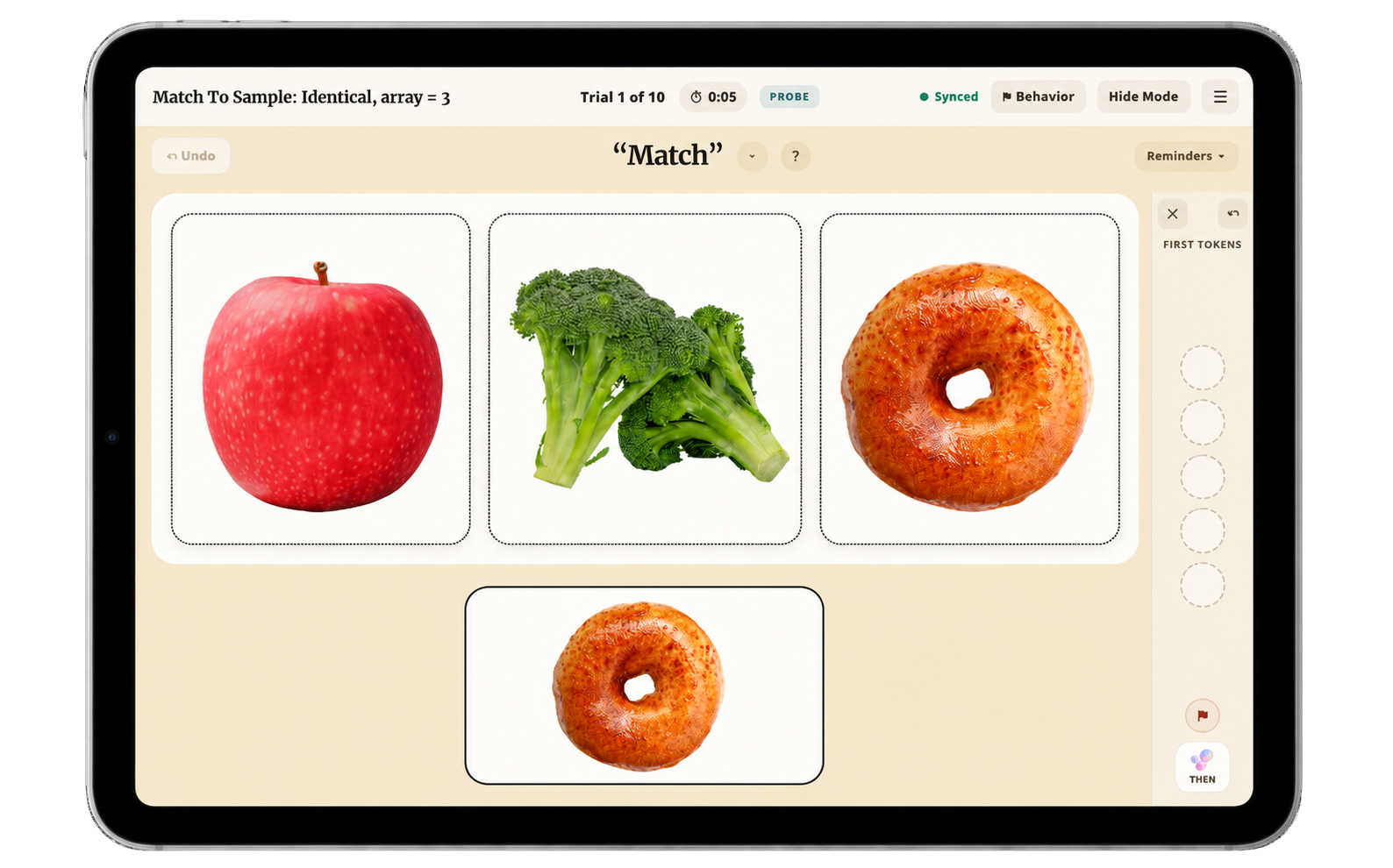
After: ABYou on a tablet, showing a match-to-sample exercise with apple, broccoli and bagel picture cards and a token board.
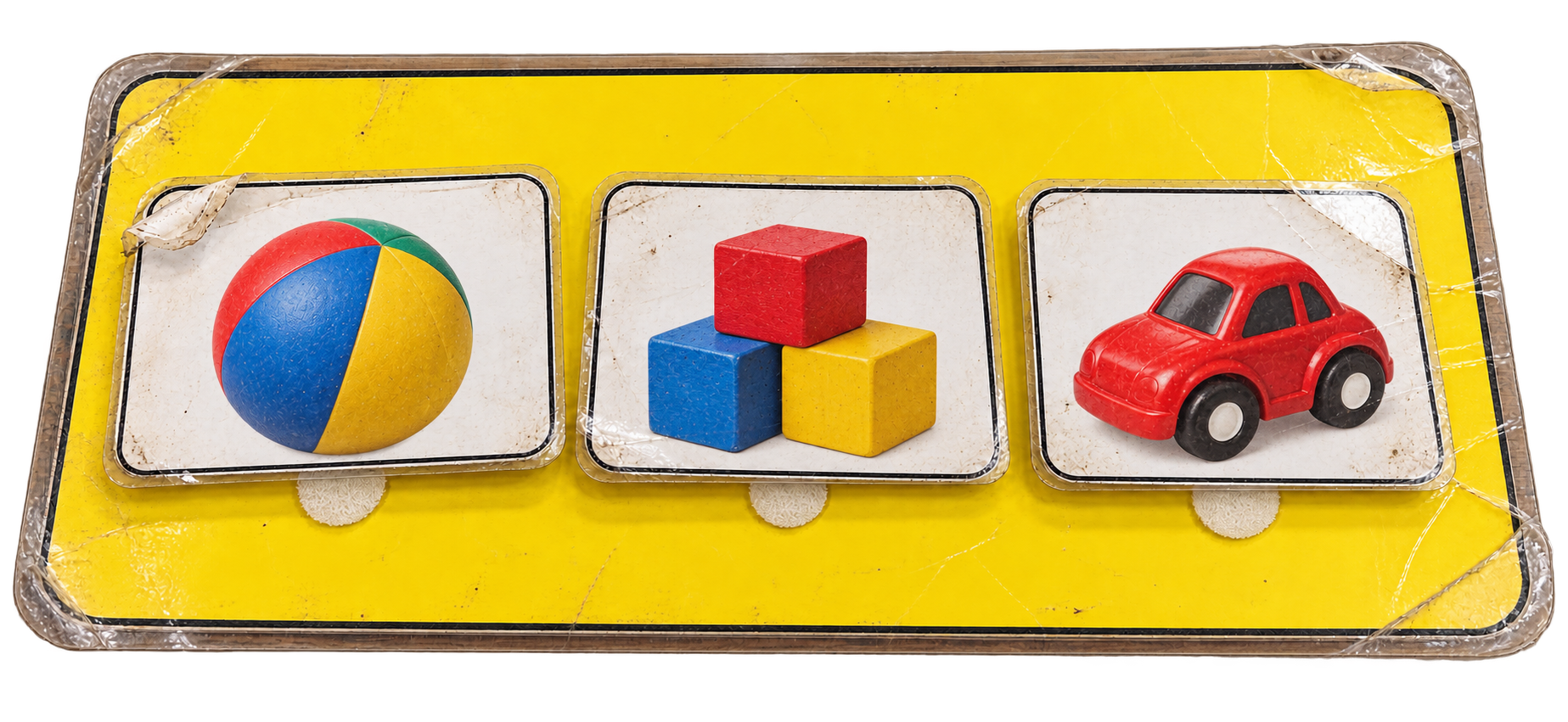
Before: a worn yellow laminated array board with removable picture cards of a ball, blocks and a toy car.
Problem
DTT runs on laminated flash cards. They get lost, wear out, take hours to make and stay at the clinic.
My role
Solo founder. I owned the research, strategy, UX, UI, design systems and prototype.
Timeline
2026 to present
Pre-launch
Outcome so far
A working DTT prototype, two design systems and a measured pilot plan with a partner clinic.

01 · Context & stakes

Minute 12. The "dog" card is gone.

In DTT, a therapist (RBT) shows a few picture cards, gives an instruction and rewards the right answer, dozens of times a session. Every trial depends on the right card being in the right hand.

A session today

  1. -15:00Dig through the bin for this learner's binder
  2. 00:00Lay out cards, shuffle positions by hand
  3. 12:00Target card missing. Learner waits.
  4. 12:40Swap in a worn card, rebuild the array
  5. 45:00Record data on a second device
  6. AfterParent asks for cards. Gets a photocopy.

Composite scenario from clinical experience

A session with ABYou

  1. -01:00Open the learner. Programs are already loaded.
  2. 00:00Array appears, positions rotate automatically
  3. 12:00Every card is there, every time
  4. 12:05Learner taps. Feedback and token, instantly.
  5. 45:00Clinic data system stays the record
  6. AfterSame pictures go home on the parent's tablet

Design intent · to be measured in the pilot

For a child just learning to communicate, every stalled minute is a minute not learning.

02 · Role & boundaries

What I owned

I drove

  • Field research and synthesis
  • Competitive analysis (27+ products)
  • Materials cost model
  • Information architecture (276 screens)
  • UX/UI and two design systems
  • DTT prototype and pilot design

Others contributed

  • BCBA: observation participant and debrief
  • AI tools: drafted code under my review
  • Partner clinic and IRB: pilot study (pending)

Constraints

  • Health data (HIPAA) in scope
  • Must coexist with clinics' data systems
  • Learners distract easily
  • Runs on tablets clinics already own

Domain edge

I've worked in clinical behavioral therapy. I've run these sessions and hunted for these cards. That gave me fast access to the problem, and the reason I insisted on a formal study to check my own bias.

03 · Research

Three ways into the problem

Contextual inquiry

Watched a BCBA work

30 observations from a live assessment session. Materials and divided attention dominated.

Competitive audit

27+ ABA products

They schedule, bill and collect data. None of them run the trial, score, and sync to a parent portal.

Cost model

What cards really cost

No industry benchmark existed, so I built one from retail prices and wage data.

Affinity map · 30 field notes → 7 clusters

From one BCBA intake session, de-identified. Quotation marks are the BCBA's own words.

A

One clinician, three jobs

5
  • O-01Carries a backpack of physical stim, a flipbook, a printed VB-MAPP on a clipboard and a pen, all at once.
  • O-02Functionally down a hand for the whole intake unless practicum students are there to carry or take data.
See more...See less notes in One clinician, three jobs
  • O-03After every trial, stops interacting with the client to write notes and score + / − on paper.
  • O-04Set the clipboard on the floor and forgot it. By the time it was back, the client no longer wanted to leave the room.
  • O-05Asked the observer to break observation and fetch stim mid-assessment.
B

The stim supply chain

5
  • O-06Once forgot the entire stim backpack. The intake paused and the flow broke.
  • O-07The flipbook is homemade: Word doc → print → laminate → hole-punch → binder.
See more...See less notes in The stim supply chain
  • O-08Client wandered into another room. The needed stim wasn't in the bag, so the therapist scavenged cabinets.
  • O-09Visual-tracking stim has to be something this client cares about, and it may not be in the pre-packed bag.
  • O-10Needs sound-making and cause-and-effect toys on demand.
C

The client sets the agenda

6
  • O-11Client wanted the swing during the puzzle probe. The therapist pulled them off, held attention on the floor and squatted to run the trial.
  • O-12Motor imitation probed on the fly: client on the play structure, looking over. “Do this” + clap.
See more...See less notes in The client sets the agenda
  • O-13Client wanted to color. The therapist rushed around finding markers and paper.
  • O-14Client wandered into another room mid-assessment. The assessment followed.
  • O-15Respond-to-name probed in the flow of things, both distracted and not.
  • O-26In the coloring rush, opened the marker box without withholding it, missing the mand opportunity, then fell back to “can you say open?” → “say O.”
D

Improvised stimulus control

3
  • O-16To shrink a matching array 6 → 3 → 1, covered pictures with post-its, pulled the page from the binder, then gave the SD “match.”
  • O-17 · verbatim“A way to control array size in the moment would be helpful.”
See more...See less notes in Improvised stimulus control
  • O-18 · verbatim“The option to place blank distractor cards in the array would be helpful.”
E

Data capture under motion

4
  • O-19Lots of clarifying notes written for every program trialed.
  • O-20Open question: how do you quickly mark notes and data when the client moves this much?
See more...See less notes in Data capture under motion
  • O-21Tracks duration, frequency and latency, per program and per behavior.
  • O-22Behavior definitions are individualized and written case by case.
F

Finding the right program

3
  • O-23Flips through the printed VB-MAPP hunting for the next program to try.
  • O-24Gains attention, asks “can you do this?” and jumps into motor imitation. Order follows opportunity, not the form.
See more...See less notes in Finding the right program
  • O-25Barriers assessment challenge: assessing a client who is always moving or not attending.
G

After the session

4
  • O-27Debrief covers highs, lows and things noticed, walked category by category.
  • O-28Needs a place in the intake for miscellaneous notes and thoughts.
See more...See less notes in After the session
  • O-29Wants re-assessment for the same client, plus mock treatment plans for practicum students.
  • O-30The next step after intake is writing the treatment plan.

"A way to control array size in the moment would be helpful."

BCBA, mid-session · verbatim

Three findings carried straight into DTT design:

  • Physical stim is the bottleneck
  • Attention is zero-sum
  • Clinicians already hack workarounds

04 · The solution

One DTT session, end to end

Every role touches the same stimulus set, so nothing is copied, lost or rebuilt.

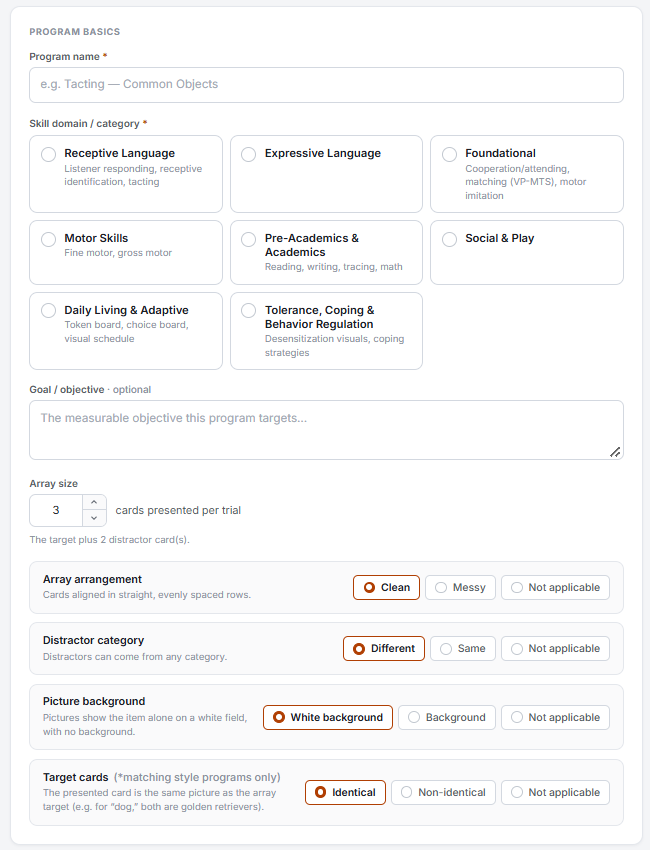
  1. ABYou program creation form with program name, skill domain, goal, array size and picture-card settings. BCBA assigns

    Targets, pictures and trial mode per program

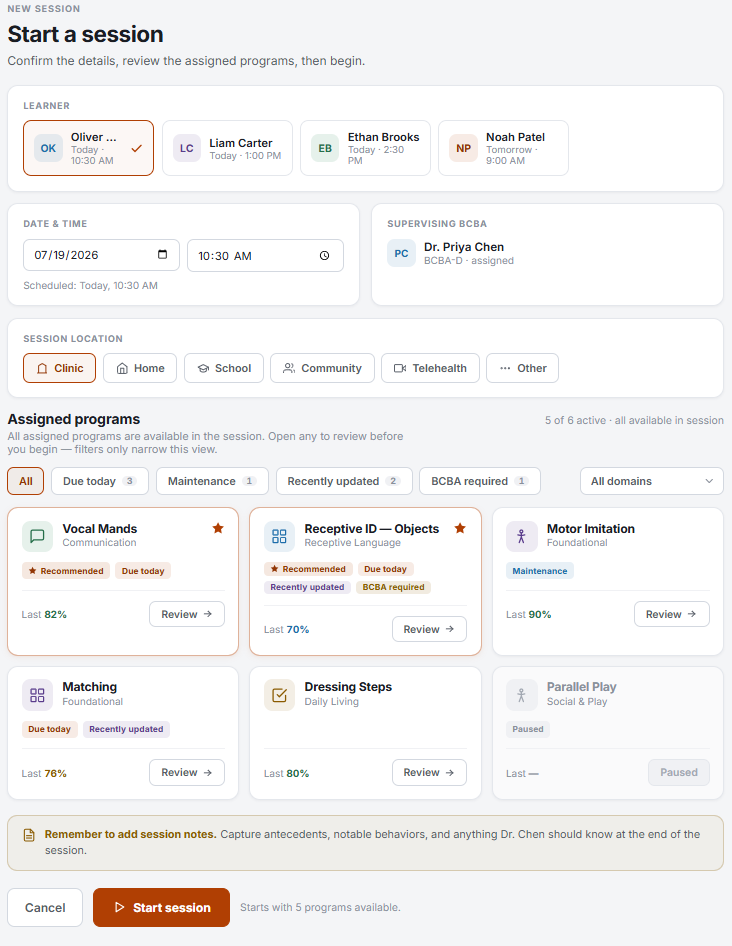
  2. ABYou RBT session setup with learner selection, date and time, supervising BCBA, session location and assigned programs. RBT opens session

    Setup sheet replaces the binder hunt

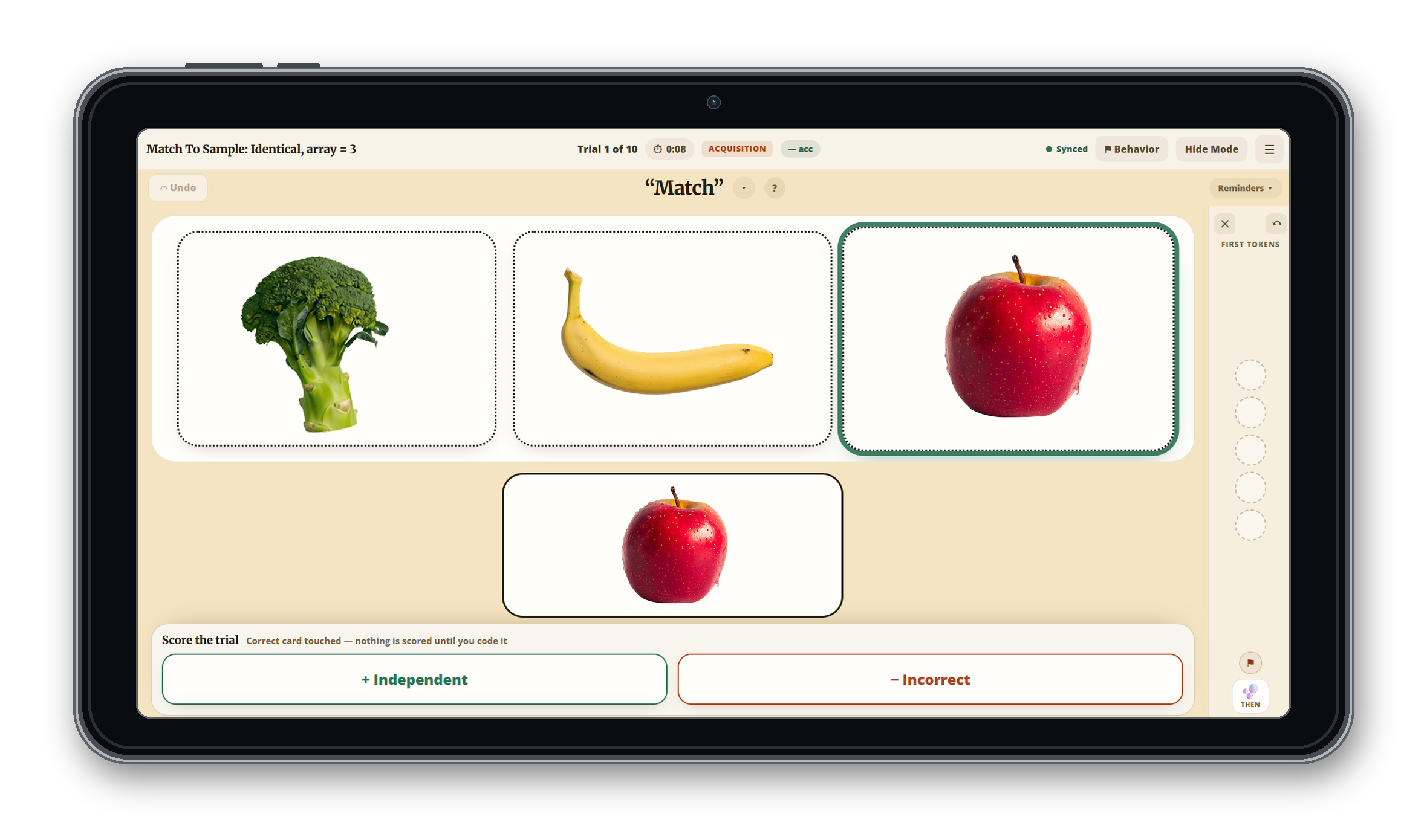
  3. ABYou learner trial with a match-to-sample exercise, three picture cards and a token board. Learner taps.

    Array rotates, runs error correction if needed.

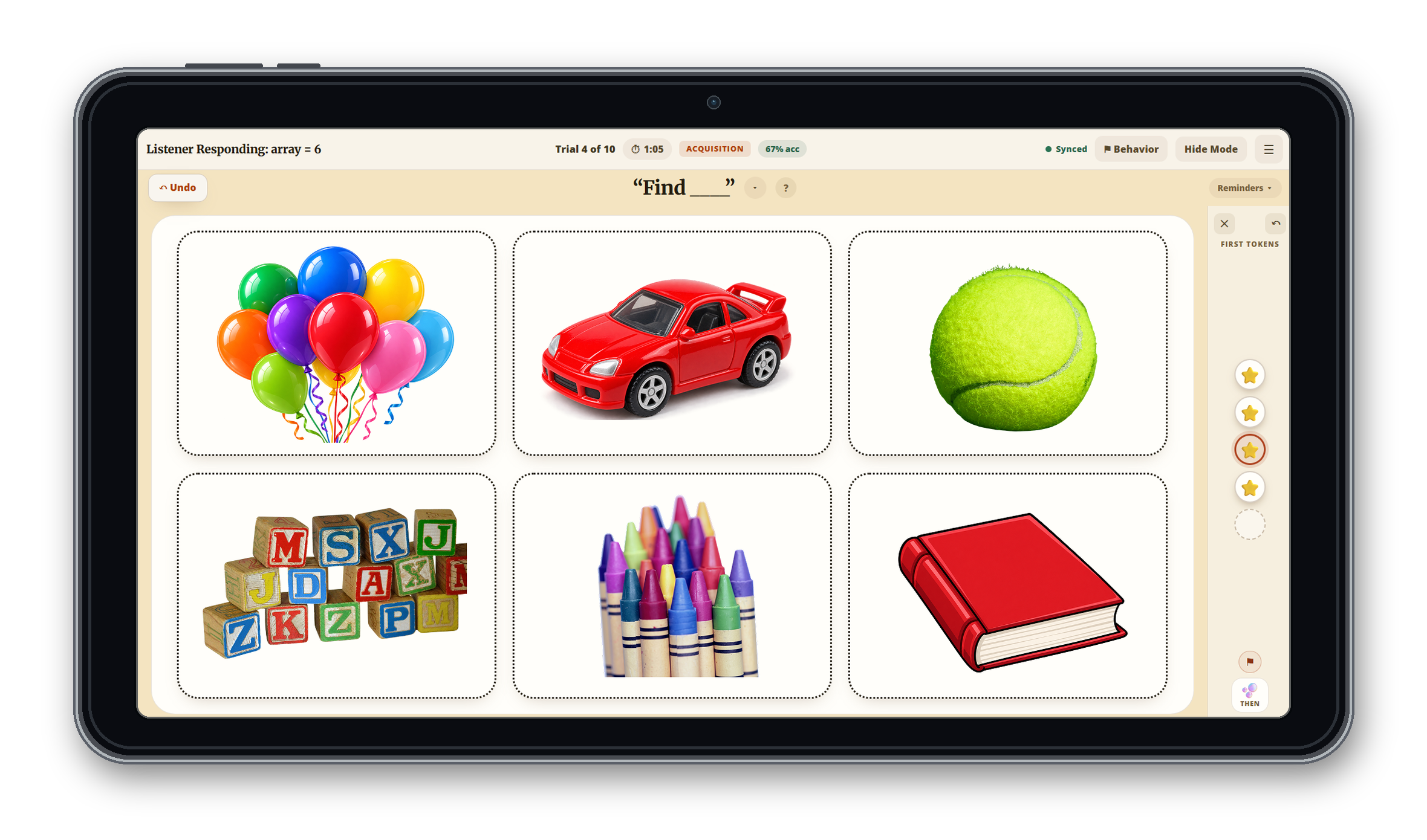
  4. ABYou listener-responding trial with six picture cards and a token board for reinforcement. Reinforce

    Token board fills, reward received.

  5. ABYou parent home on a tablet with recommended home practice, assigned programs, recent practice and care-team messages. Home practice

    Same targets, same pictures, same prompts

ABYou learner trial on a tablet: Match to Sample, identical, array of 3. The instruction “Match” sits above photos of an apple, broccoli and a bagel, with a bagel sample card below. Trial 1 of 10, a timer, a Probe tag, a Synced status, Behavior and Hide Mode controls, and an empty token board on the right.
Learner trial · Listener responding. Only the instruction, the pictures and the tokens reach the learner.
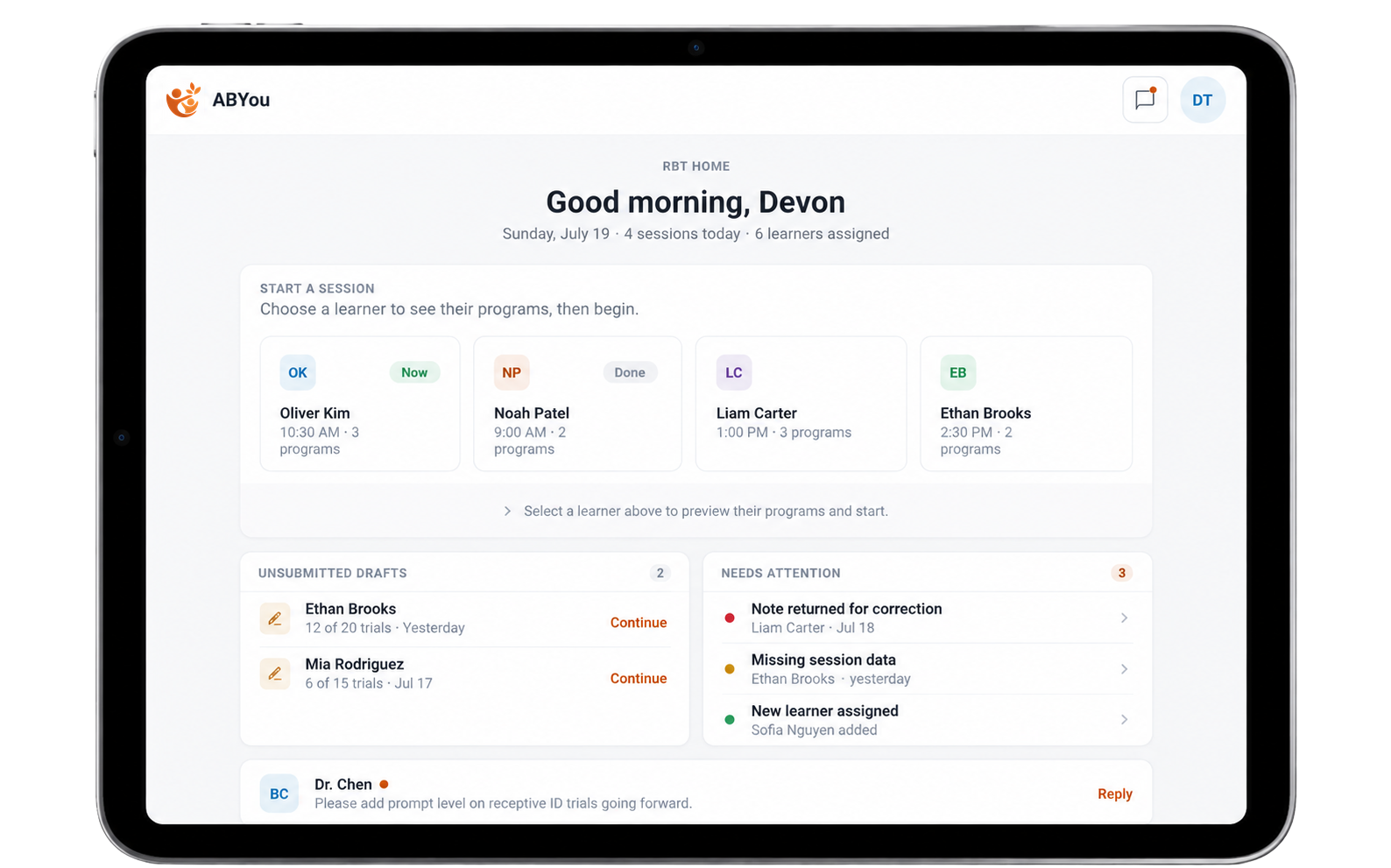
ABYou RBT home on a tablet: Good morning, Devon. Four learner session cards for today with times and program counts, unsubmitted drafts with Continue links, a Needs attention list, and a message from the BCBA asking to add prompt level on receptive ID trials.
RBT home · Today's learners, unfinished drafts and BCBA notes in one place
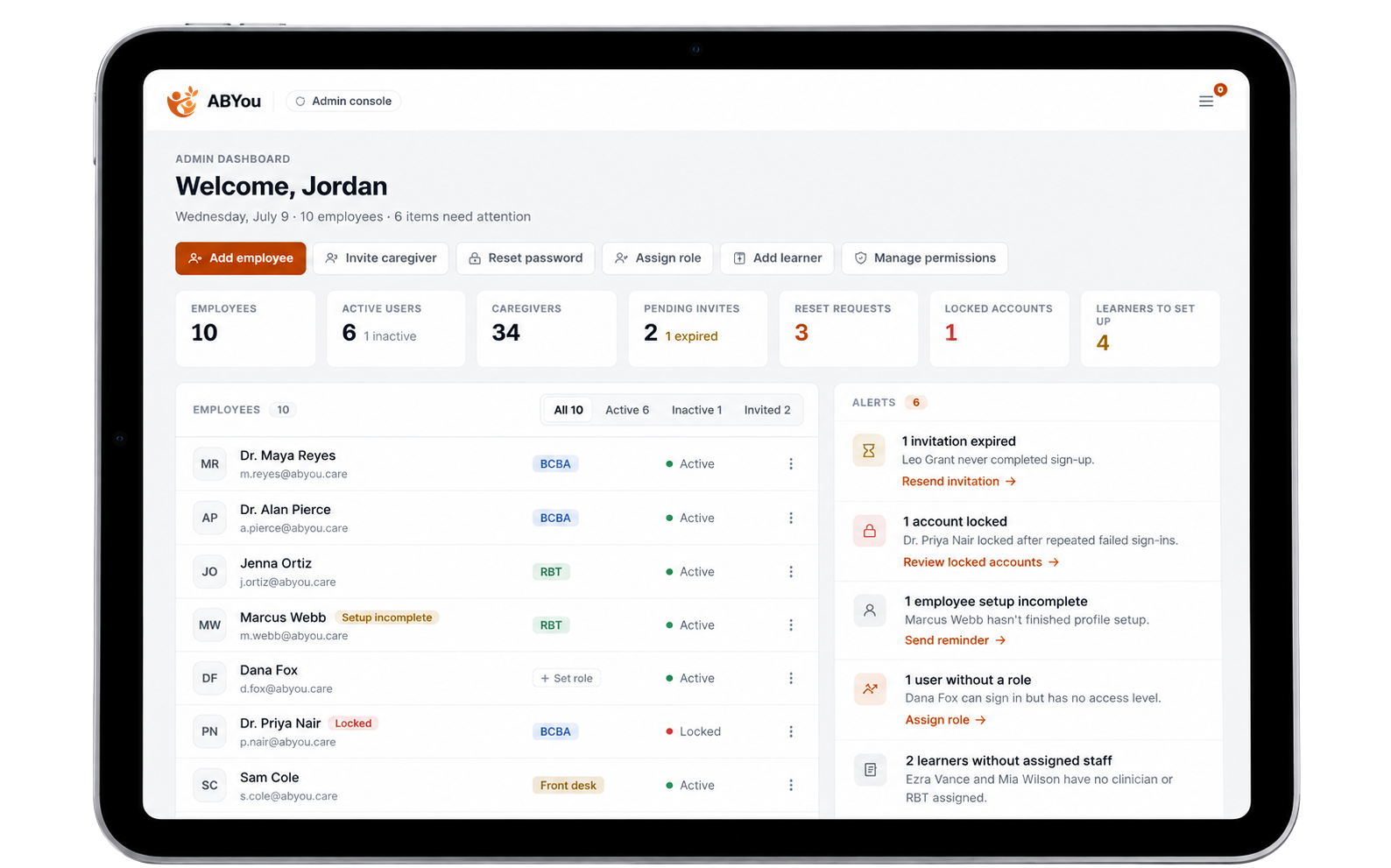
ABYou admin console on a tablet: Welcome, Jordan. Quick actions such as Add employee and Invite caregiver, counts for employees, invites, reset requests and locked accounts, an employee list with roles and status, and an alerts panel.
Admin console · Staff, roles, caregiver invites and account alerts

05 · Key decisions & trade-offs

Four calls that shaped the product

1

Put the stim on the tablet already in the room

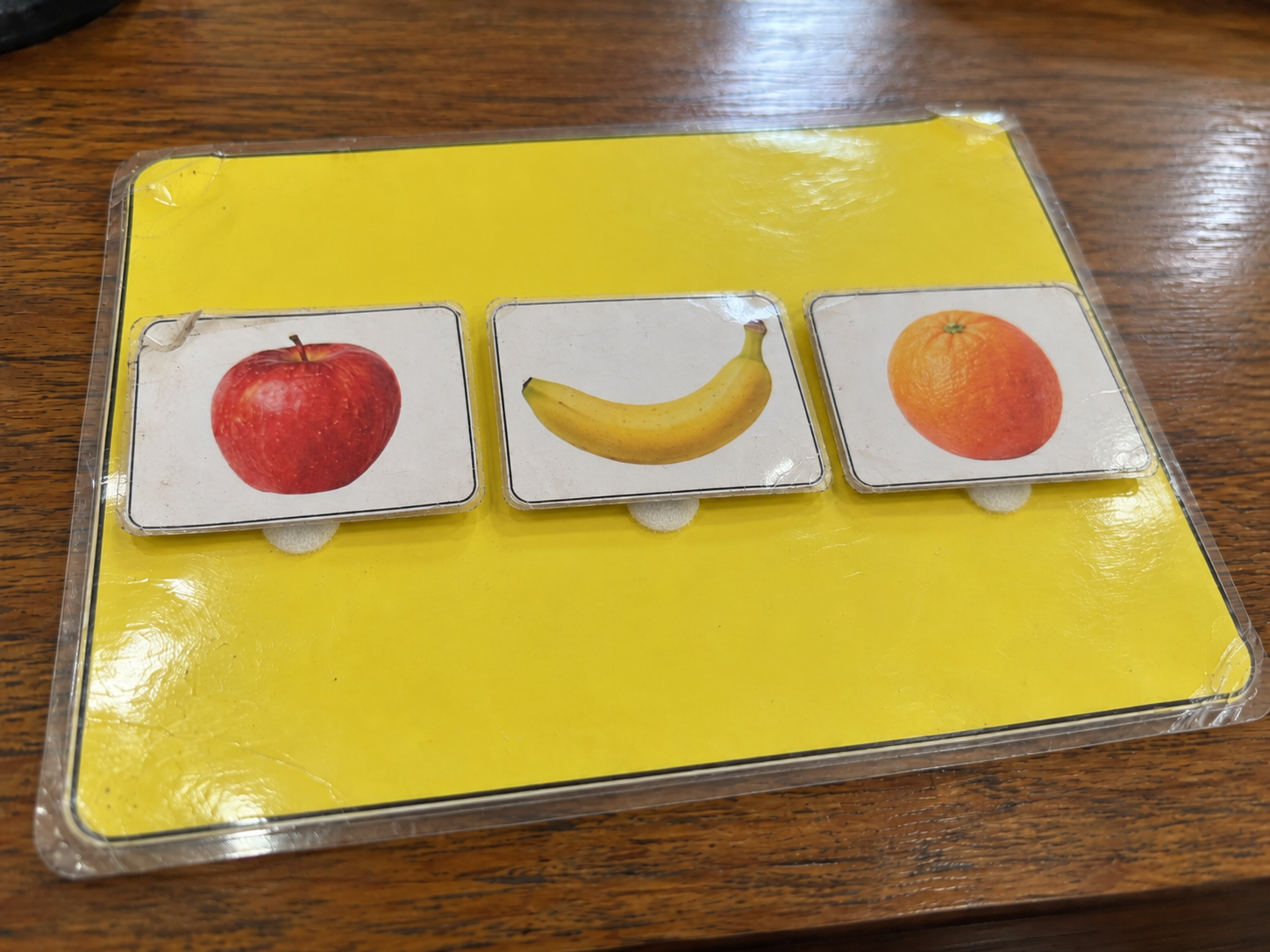
Better bindersCommercial card setsPrintable libraryDigital stim on clinic tablets
Before
Laminated stimulus learning board with removable apple, banana and orange picture cards.

Print, cut, laminate, velcro. Then a card walks off.

After
ABYou learner trial on a tablet with a match-to-sample exercise, three picture cards and a token board.

Nothing to make, lose or replace.

WhyClinics already own tablets. No new hardware, no new budget line.
Trade-offSome programs need real objects. ABYou covers picture-based programs and doesn't pretend otherwise.
2

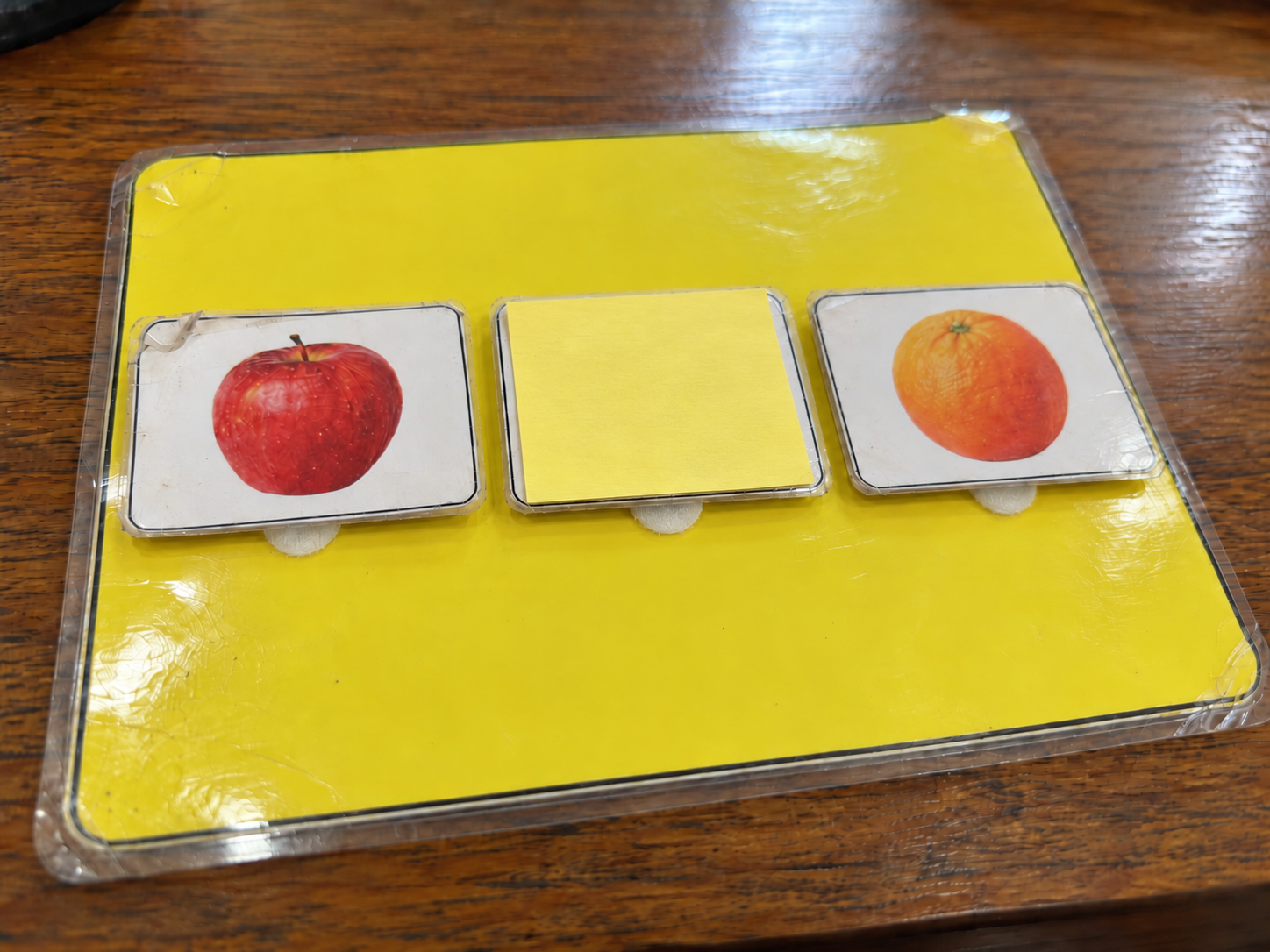
BCBA wants to test different array sizes

Improved workaround such as post-its.One click and array is resized.
Before · observed workaround
Laminated stimulus board with a yellow sticky note covering the center picture card between apple and orange cards.

Post-its to shrink the array from 6 cards to 1.

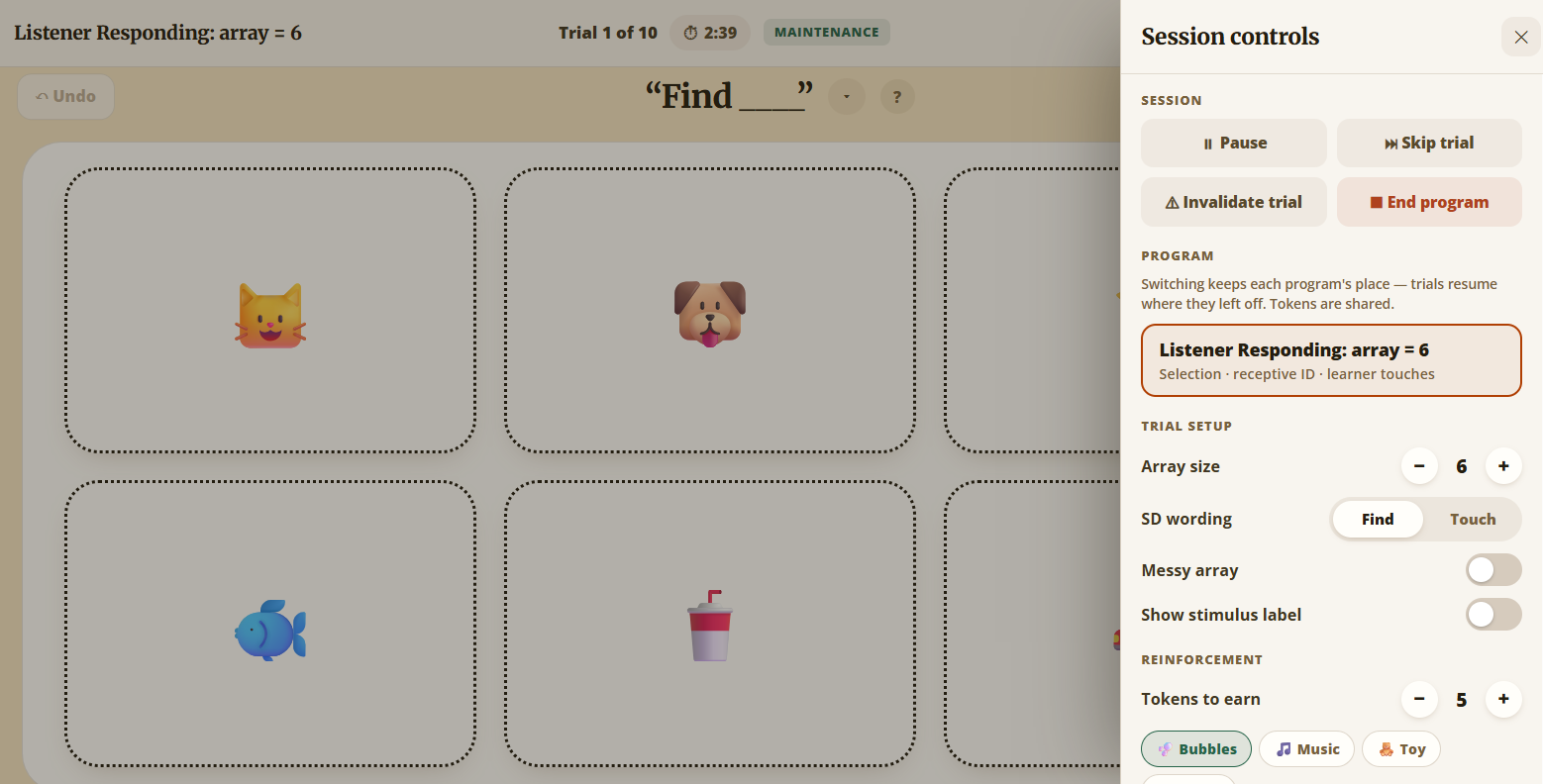
After
ABYou listener-responding trial with the Session controls panel open, showing array size, instruction wording, stimulus settings and reinforcement options.

One tap to resize. Blanks on demand. Positions rotate on their own.

WhyThe RBT's eyes go back to the child instead of the cards.
Trade-offA tablet can distract. Learner screens show only the instruction, the pictures and the tokens.
3

Supplement the clinic's data system; let the BCBA pick the mode

Replace the data systemOne fixed scoring ruleMode per program, data stays in their system
Errorless learningApp logs + / −. The RBT records the prompt level in the clinic's system.
Error correctionApp runs the correction sequence itself, hands-free.
WhyClinics won't give up their system of record. Competing with it would block adoption.
Trade-offIn errorless mode, the RBT still uses two apps. That's the fairest objection, and the pilot will test it.
4

Send the same stim home

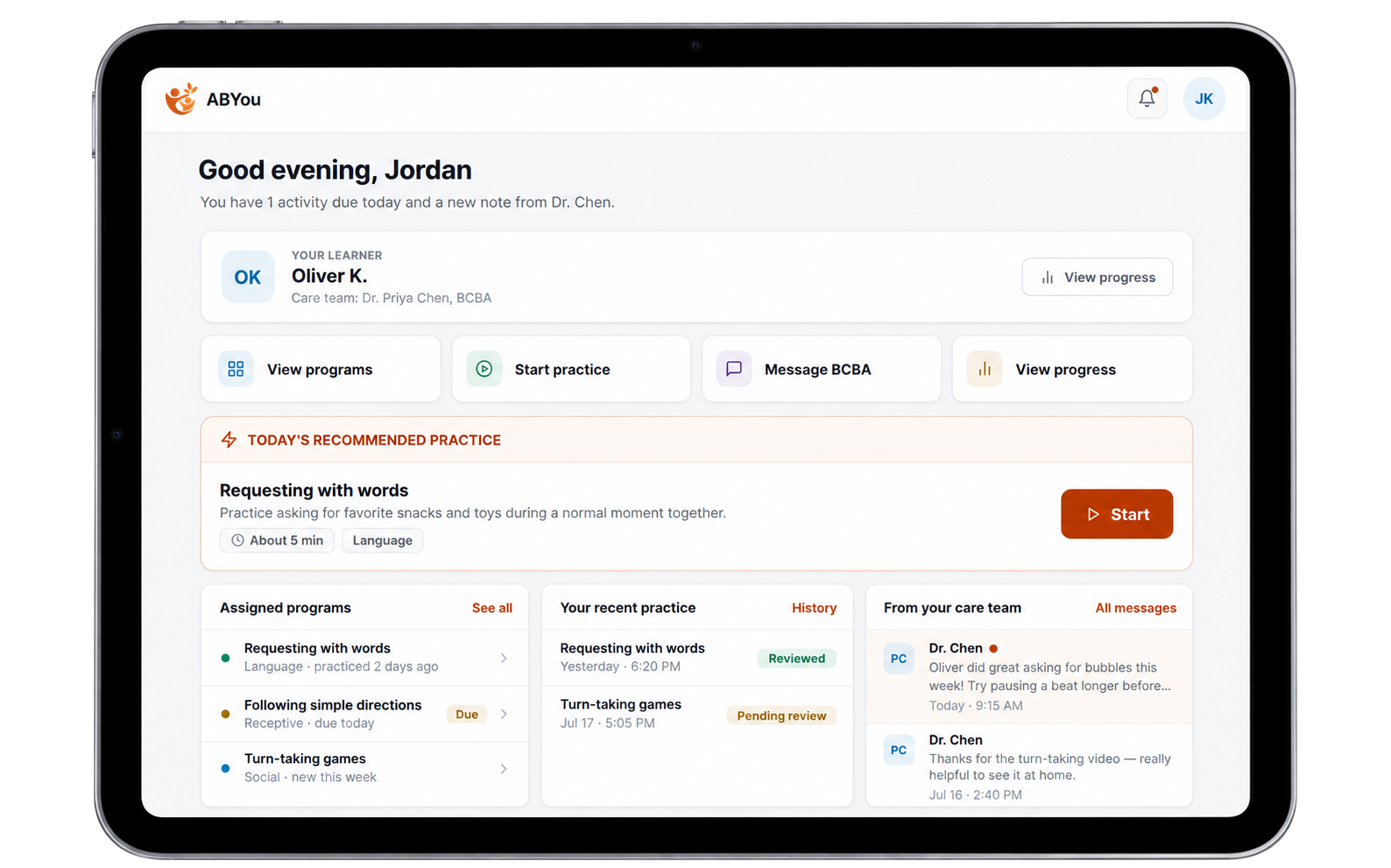
PhotocopiesGeneric learning appsParent view of the clinic's exact programs
ABYou parent home on a tablet: Good evening, Jordan. Learner card for Oliver K. with his care team, a recommended practice called Requesting with words with a Start button, assigned programs, recent practice marked reviewed or pending, and messages from the BCBA.
Parent home · Today's practice uses the clinic's targets, with the BCBA a message away
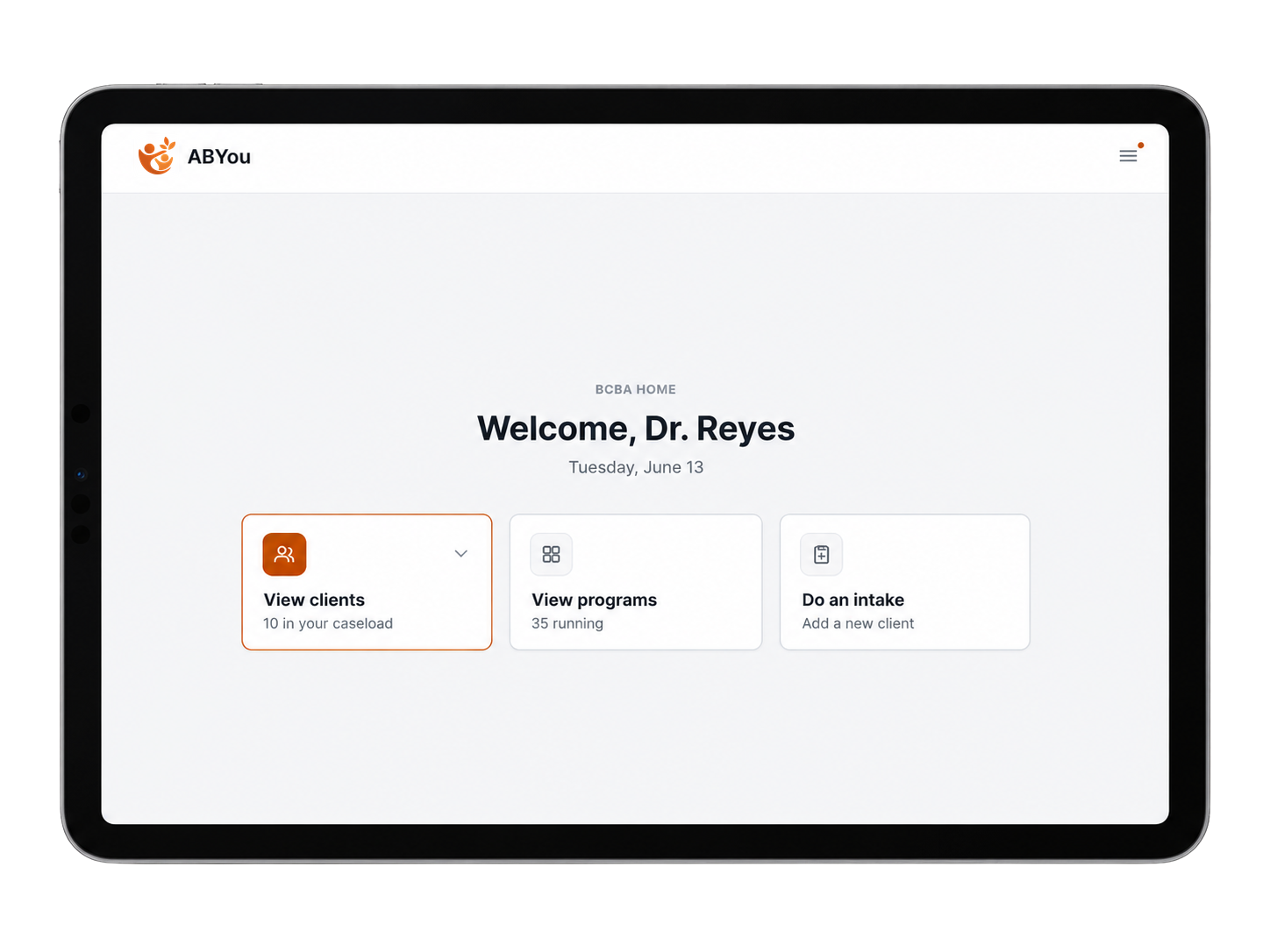
ABYou BCBA home on a tablet: Welcome, Dr. Reyes. Three large actions: View clients, 10 in your caseload; View programs, 35 running; and Do an intake.
BCBA home · Clients, programs and intake, three taps from anywhere
WhySkills that only show up at the clinic table aren't fully learned. Home practice needs to match.
Trade-offParents aren't trained RBTs. Home mode is simpler, and the BCBA controls what goes home.

06 · Outcome & evidence

The case before the pilot

Pre-launch, so no usage metrics yet. Here's the evidence I built, and exactly what the pilot will measure.

Cost model · 30-learner clinic

360 hrs

A year of staff time making materials

About $9,700 in wages, mostly unbillable.

Supplies

$1,200

A year in paper, ink, lamination and velcro

89% of the cost is hours, not supplies.

Adjacent research

>70%

Less prep time when a tablet replaced paper picture cards

Communication cards, not DTT, and n = 11. A signal, not proof.

The cost model is my own bottom-up estimate. Prep hours are its weakest input, which is why the pilot measures them directly.

Reusable patterns

2

Design systems + component library

The data-driven trial engine runs new programs without new screens.

Edge-case coverage

276

Screens across 5 roles

Includes error, support and edge paths, not just the happy path.

Market gap

0

Of 27+ products run the trial itself

ABYou's position: session-native trial delivery.

Accessibility · WCAG 2.2 contrast audit of my own tokens

ABYou product color contrast audit
Pair Use Ratio Result
AaLearner ink Trial instruction 15.4 : 1 Pass AAA
AaWhite on go green Correct badge 5.7 : 1 Pass AA
AaBrand accent Clinician actions 5.7 : 1 Pass AA
AaTertiary ink Clinician meta text 3.1 : 1 failed for body text • updated to #6E7481 to 4.68:1 AA

Heuristic evaluation

Planned

Peer review against Nielsen's 10

A peer evaluation of the trial screen is planned. Severity ratings and resulting fixes are not yet available.

Stakeholder feedback

Pending

Prototype feedback

Feedback from RBTs, BCBAs and design peers will be added after prototype review, once documented feedback is available.

Pilot · 4 weeks · 2 BCBAs · 4–6 learners

What the pilot measures

Prep min

Per session, baseline week vs. final week

Trials

Per session, same learner, before vs. after

Pulse

RBT and BCBA survey on effort and fit

Home

Practice sessions families actually complete

  1. Research + prototypeDone
  2. IRB-reviewed pilotAwaiting approval
  3. MVP iterationFrom pilot data
  4. LaunchTarget 2028

Sources: cost model built from BLS wage data (May 2025) and retail prices (Sept 2026) · Chien et al. (2015), iCAN, International Journal of Human-Computer Studies 73, 79–90 · competitive audit of 27+ ABA products (2026).
07 · The hard question

"So the RBT is using two apps at once?"

Sometimes, yes. In errorless mode, ABYou presents the trial and the clinic's system keeps the record. I chose that over asking clinics to switch data systems, which most won't. The pilot measures whether the extra tap costs more time than the materials save.

I'd test earlier

I built architecture and design systems before any clinician touched the trial screen. A paper test in month one would have been cheaper.

Scoping out is design

Not replacing the data system made the product smaller and easier to adopt.

Users prototype too

The best requirement came from watching a post-it workaround, not from asking.

The cards will keep getting lost. The learning doesn't have to.

Next case study
Project Rewire