HCDE 590–591 Capstone · MindOS
Case Study · TikTok Extension · Behavioral Design

Project
Rewire

A TikTok-integrated extension that detects passive scrolling and redirects users toward meaningful engagement without reducing user autonomy.

Role UX Researcher & Occasional Designer
Platform TikTok · Mobile extension
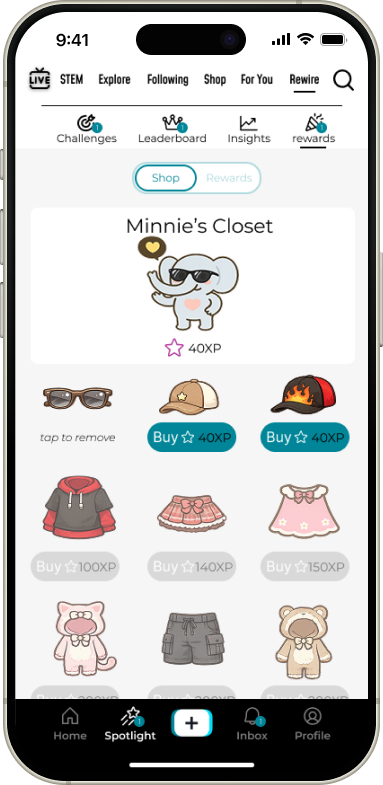
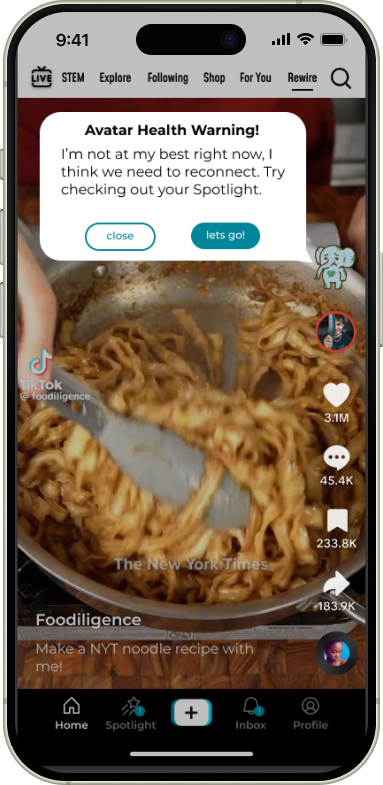
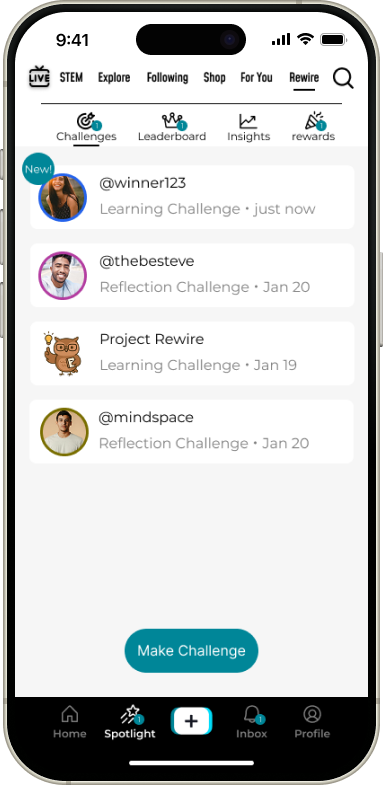
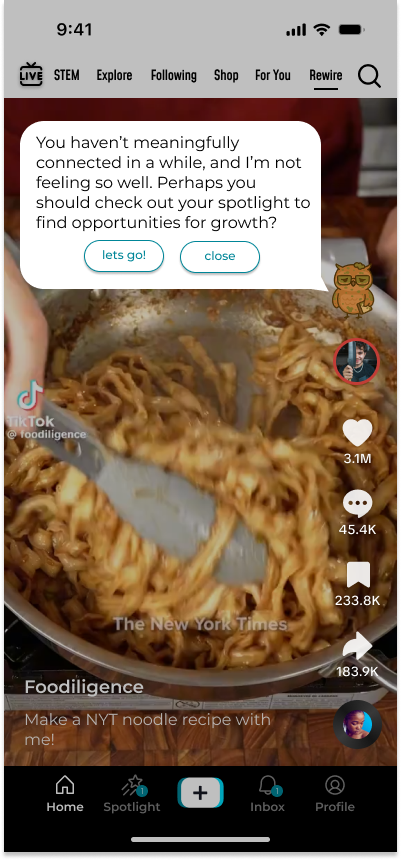
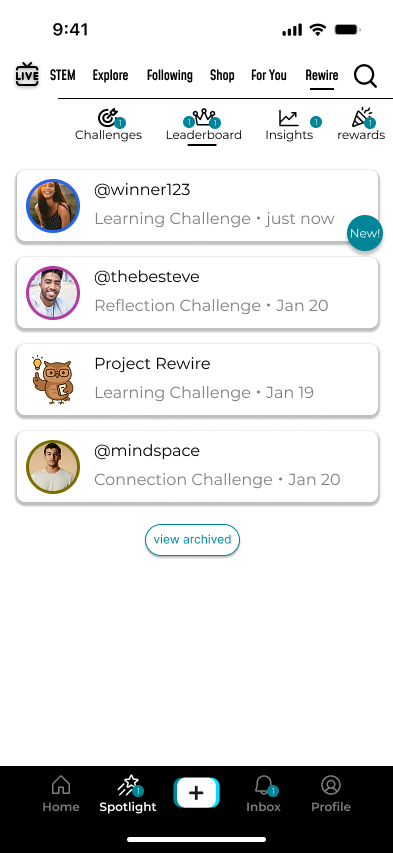
Project Rewire avatar customization screen Project Rewire threshold prompt screen Project Rewire challenge selection screen
22
Literature sources
2
Expert Reviews
27
Total research participants
4
Avatar archetypes
The Problem

Brain rot is a design problem.

Short-form content platforms are engineered for maximum engagement, not user well-being. As a result, users frequently experience a loss of control over their time, attention, and intentions. Project Rewire is a behavior-change intervention that introduces intentional friction, real-time awareness, and adaptive feedback loops to help users regain control without removing autonomy. Unlike traditional solutions (screen time limits, app blockers), Rewire focuses on aligning user intention with actual behavior, not simply reducing usage.

Passive, automatic scrolling
Attention fragmentation
Reduced critical thinking
Cognitive fatigue
Emotional overstimulation
Weakened social connection
Design Question
How might we redesign traditional gamification elements to foster more meaningful engagement on social media, and reduce the cognitive effects of brain rot?
01 — Research

Five methods. One clear picture.

22
Literature sources
7
Competitors analysed
5
1:1 Interviews
2
Focus groups
2
Synthesis methods
ArtifactCurrent-State + Future-State Journey Map
Think-Aloud + Interviews
Current State
With Rewire
ScopePassive scroll session, evening context
01 — User Journey Map

What it feels like to lose control.

A dual-state map contrasting the current unintentional scroll loop (red) with the intervention-supported journey enabled by Rewire (purple). Grounded in think-aloud session data and behavioral self-reports. The emotional arc is the diagnostic tool — the gap between the two lines is the design opportunity.

Sara L.
Primary Persona · "The Aware Addict"
Age22 · College senior
Usage~2.5 hrs/day TikTok
TriedScreen Time, deleted + re-downloaded
GoalUse TikTok intentionally, for learning & connection, not default boredom fill
DriveOwl (Smart archetype/Learn Drive): seeks novelty and knowledge
"I know it's bad for me but I literally can't stop. I open it without even thinking."
Current state (without Rewire)
Future state (with Rewire)
Pain point
Rewire intervention
Stage
01
Trigger
Bored, procrastinating
02
Opens App
Automatic reflex
03
First Videos
Hook established
04
Deep Scroll
20–30 min in
05
Time Distortion
Suddenly notices
06
Guilt Spike
Tries to stop
07
Re-entry Loop
"Just one more"
08
Session End
Eventually closes
Doing
Studying Waiting Lying in bed
Unlocks phone Opens TikTok (no decision made)
Scrolls For You Page Watches 5–8 videos
Continuous passive scroll Liking, re-watching clips
Checks time Feels shock
Closes app Puts phone down
Picks phone back up Re-opens TikTok
Closes phone for real Tries to sleep / study
Thinking
"I'll just relax for a few minutes."
"I didn't even decide to open this."
"This is actually really funny / interesting."
"OK just a little longer. This one looks good."
"Where did the last hour go?!"
"I'm so bad at this. I have no self-control."
"One more video won't hurt. I'll stop after this."
"I feel exhausted and I didn't even do anything."
Emotional Arc
+ ·
Positive Neutral Negative Peak (current) Peak (rewire) Guilt crash
Pain Points
No awareness of intent or need state
Zero friction at point of entry — 100% automatic
Algorithm immediately delivers high-value content that escalates engagement
No time signals
Session feels shorter than it is
Shock of time loss causes acute distress
Awareness arrives too late
Self-blame language: "no self-control"
Shame reinforces the loop
"Just one more" loop — exit attempts fail 3–4× before succeeding
Cognitive fatigue
Reduced focus for subsequent tasks
No reflection or learning
Rewire
No direct intervention — trigger is internal state, not app behavior.
↳ Intentional Entry
Pre-behavior check: "Why are you opening this?" + time expectation prompt. Inserts conscious decision where none existed.
First few videos are intentional — entry intent set.
↳ Real-Time Awareness
Subtle elapsed-time surface during scroll. No alarm — just ambient awareness restoring time perception.
↳ Adaptive Friction
Avatar prompt appears at user's self-set threshold. Dismissable. Offers Learn / Connect / Reflect alternatives.
No shame-based messaging — neutral tone throughout.
Progressive friction escalates: delay → prompt → re-entry barrier.
↳ Reflection Loop
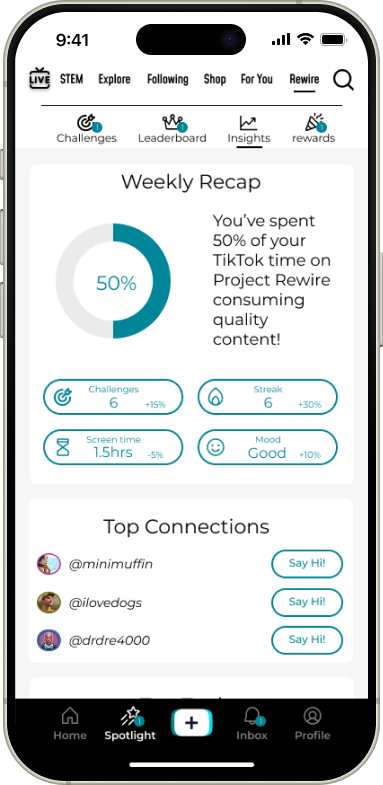
Post-session: intended vs. actual time, behavioral trend. Session becomes a learning loop, not a waste.
ArtifactThematic Affinity Diagram
Interviews + Focus Groups + Literature
Participants11 (5 interviews + 2 focus groups)
Notes coded~90 observations → 5 clusters
02 — Affinity Diagram

Five clusters. One system leveraging behavioral complusions.

Raw observations from interviews, focus groups, and behavioral science literature were clustered into five thematic groups. The consistent thread: users are not failing, the platforms are using complusive behaviors. Every cluster points back to a systemic design problem, not a willpower deficit. Five underlying requirements appeared.

5
Underlying Requirements
Relief from boredom or stress
7 observations · Mental decompression
"When I need a good laugh or I'm looking for inspiration," "[it gives me] self-expression and creativity." "laughter, inspiration, escape" "I scroll when I'm waiting for literally anything." "Comedy brings me joy in the day." "I've opened it 5 times while trying to stop." Habit loop: cue → routine → reward fires without conscious mediation
Sense of Community & Belonging
5 observations · Meaningful Connection failure
"I appreicate the newer influencers speaking about their own expereinces. I feel better even though I don't actually know them." "Finding solutions in common hobby groups [Subreddits] is helpful social media to me." "I feel informed... trying to keep up on news" "...shared art boards or styles, I really grow from feedback but construction comments [versus mean comments with no gudiance] are hard to get." "I like finding people that are going through the same things as me." Users find a sense of connection with others, even those they don't know, through shared experiences or emotions.
Balance between Engagement & Wellbeing
7 observations · Responsible social connection
"I almost always feel like I could have done something better with my time." "I feel stuck & can't stop" "Fatigue and overstimulation: Long sessions cause exhaustion and anxiety." "I feel FOMO if I'm not on it." "I look up and it's dark outside. Where did my day go?" "I use it for everything from information to inspiration to just random funny videos." Social media satisfies Drive to Bond & Learn — but in a meaningful, responsible way
Alignment with Personal Identity
4 observations · Resonating with users
"If I don't vibe with it, I just swipe." "I like being able to share my experiences and how I see it [through art]." "I follow people that have the same experiences as me." "I really miss how you could put so many 'favs' on MySpace, like top songs and glitter fonts or whatever." The change mechanism needs to feel like it matches users style or they'll abandon it.
Progress & Recognition
6 observations · Visible Achievements & Results
"Honestly, I just want to win." "I like to goal set in ways that adds, not take away." "Winning... getting to that goal keeps me coming back." "Seeing my pieces come together entices me to keep going." "The satisfaction of completion... I was able to figure it out." "As long as I can see I'm getting somewhere, I'll keep trying."
Research Synthesis: Key Insights
01
The need is real. It's the delivery mechanism that is problematic.
Clusters 1, 2, and 3 reveal that social media satisfies genuine social and cognitive needs: learning, belonging, decompression. The goal is not to eliminate these needs but to fulfill them more intentionally. Rewire's challenge system is a direct design response to this finding.
02
Personalization is key.
Cluster 4 shows a clear pattern: users need something that meets and works with their goals and their mental models.
03
Seeing results keeps the momentum of change.
Cluster 5 reveals users need to visibly see and be reminded of their goals when trying to change to keep themselves on track.
ArtifactCompetitive Landscape Analysis
7 Platforms Reviewed
Dimensions7 evaluated criteria
FocusGamification & behavioral engagement platforms
03 — Competitor Analysis

Seven platforms. One clear gap.

Across seven gamification and engagement platforms, no competitor builds toward intentional behavior change grounded in behavioral science. Most rely on extrinsic reward loops — points, badges, leaderboards — without addressing the psychological root of passive or automatic engagement. Rewire occupies the intersection that others miss: intrinsic motivation, adaptive timing, and autonomy-preserving design.

Platform Primary Context Gamification Model Behavioral Theory Depth Motivation Type Personalization Real-Time Feedback User Autonomy
Chatter Salesforce Enterprise social collaboration Contribution scores
Extrinsic
Feed-based, passive
SharePoint Microsoft Document management & intranet None native
None
No behavioral feedback
Packback Education · AI Higher-ed discussion & inquiry Curiosity Score
Intrinsic
AI in-line as you write
Bunchball Nitro BI Worldwide Enterprise gamification Points, badges, missions
Extrinsic
~ Push notifications, missions
Centrical fmr. GamEffective Frontline employee performance Adaptive narratives
Intrinsic Extrinsic
AI coaching + microlearning
Badgeville Acq. by SAP · Deprecated Enterprise behavior mgmt. Behavior Platform
Extrinsic
~ Analytics-driven, not live
Kudos Recognition platform Employee recognition & culture Peer recognition
Extrinsic
~ Recognition feed, pulse surveys
Rewire ↗ Project Rewire · MindOS Behavioral intervention · TikTok Adaptive JITAI
Intrinsic
Avatar-driven, mid-session
Positioning Map — Intrinsic Motivation Focus × Behavioral Theory Depth
HIGH THEORY DEPTH LOW THEORY DEPTH EXTRINSIC INTRINSIC CHT Chatter SP SharePoint PKB Packback BNT Bunchball CTR Centrical BDG Badgeville KDS Kudos PR Project Rewire
Strategic White Space
Intrinsic + Theory-Grounded + Consumer-Facing
No competitor occupies this quadrant. Enterprise platforms (Centrical, Bunchball) have theory depth but target employees, not consumers. Consumer tools (Chatter, Kudos) rely on extrinsic social loops. Packback comes closest but is locked to education. Rewire is the only product built on JITAI + 4DT + CoI for everyday users.
Critical Gap 01
Extrinsic rewards don't produce lasting change.
Bunchball, Badgeville, and Kudos are built on points-badges-leaderboards mechanics. Research shows extrinsic reward loops produce short-term spikes but erode intrinsic motivation over time — users disengage once novelty fades. Rewire is designed around intrinsic alignment, not reward dependency.
Critical Gap 02
No platform intervenes at the moment of behavior.
Every competitor operates in scheduled, pre-set, or post-session modes. None use adaptive, moment-of-behavior intervention (JITAI). Rewire's mid-session intervention is a structural differentiator — it interrupts the automatic habit loop at the highest-leverage point.
Critical Gap 03
Collaboration platforms ignore behavior change entirely.
Chatter and SharePoint are communication infrastructure — they have no behavior change intent. Their "gamification" (contribution scores, badges) is a peripheral feature designed to boost platform adoption, not reshape how users relate to attention, time, or intention.
Rewire's Unique Differentiators
Motivation Model
95% Intrinsic
Alone in targeting identity-level, values-driven motivation. Every competitor leans on external reward structures. Rewire leans heavily on intrinsic motivation with extrnsic motivators just to get users started.
Intervention Type
Mid-Session JITAI
The only platform that intervenes during active behavior — not before setup or after the fact.
Theory Foundation
JITAI + 4DT + CoI
Three behavioral frameworks integrated into one system. Closest competitor (Centrical) applies one framework, in enterprise contexts only.
User Stance
Non-Coercive
Every prompt is dismissable. No penalties, no shame mechanics, no points withheld. User agency is the non-negotiable design constraint.
02 — Key Insights

Five patterns. All structural.

Research consistently pointed away from user failure and toward platform design. The problem isn't willpower — it's systems working against users' own values.

Insight 01
The Passive Consumption Loop
Users open TikTok for relief, get stuck, and feel worse. Relief → trap → guilt → repeat.
Insight 02
The Dopamine Cycle
Short-term reward → overstimulation → emotional fatigue → scroll again to reset. Users recognise the cycle but can't break it alone.
Insight 03
The Value Disconnect
Users want learning and connection — but default to mindless content. The gap between stated values and behaviour is the design opportunity.
Insight 04
Intrinsic Motivation Matters
Gamification fails with superficial rewards. Identity-driven engagement — goals that feel personal — is what actually sustains change.
Insight 05
Social Media as Emotional Tool
Users scroll for belonging, humour, and identity validation. Any intervention must address the emotional need, not just the behaviour.
Opportunity
The Design Space
Intervene at the exact moment of behaviour. Redirect, don't block. Give users control. This is the JITAI (Just-In-Time) Adaptive Intervention framework in practice.
Theoretical Foundations
Four Drive Theory
Avatar system + personalisation
Maps users to a personality-aligned avatar via core drives: Learn, Bond, Acquire, Defend.
Community of Inquiry
Three challenge types
Learn (cognitive), Connect (social), Reflect (metacognitive) — structured meaningful engagement.
JITAI
Moment-of-behavior intervention
Just-In-Time Adaptive Intervention: interrupt at the exact moment it occurs, not before or after.
03 — The Solution

A behavioral system. Not just an app.

Project Rewire detects prolonged scrolling, prompts through a personality-matched avatar, and redirects users into one of three challenge types — all dismissable, all on their terms.

Placeholder for Avatar System feature image
Feature 01
Avatar System
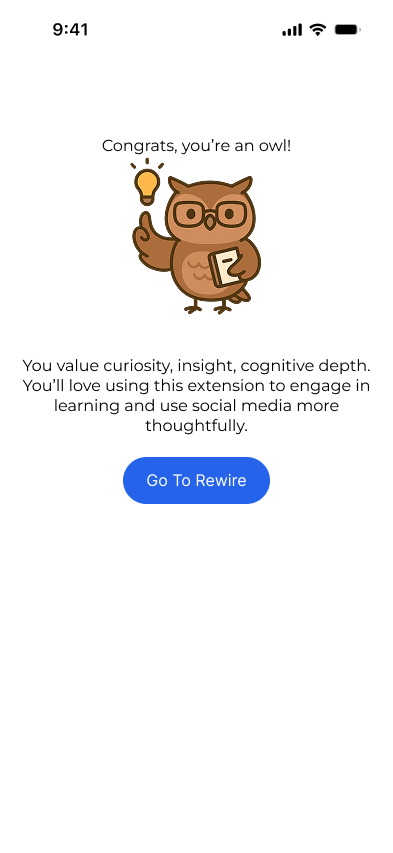
A short quiz matches users to one of four personality-aligned avatars. The avatar acts as a guide, building identity, trust, and intrinsic motivation over time.
Placeholder for User-Controlled Intervention feature image
Feature 02
User-Controlled Intervention
Users set their own scroll threshold. The avatar appears with a prompt — always dismissable. Autonomy is the non-negotiable core of the system.
Placeholder for Challenge System feature image
Feature 03
Challenge System
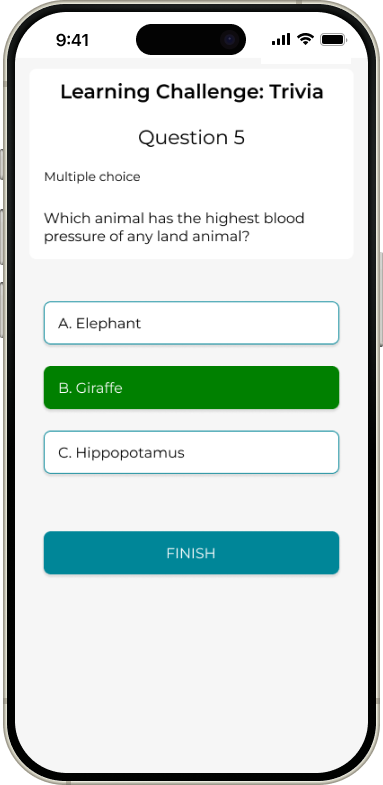
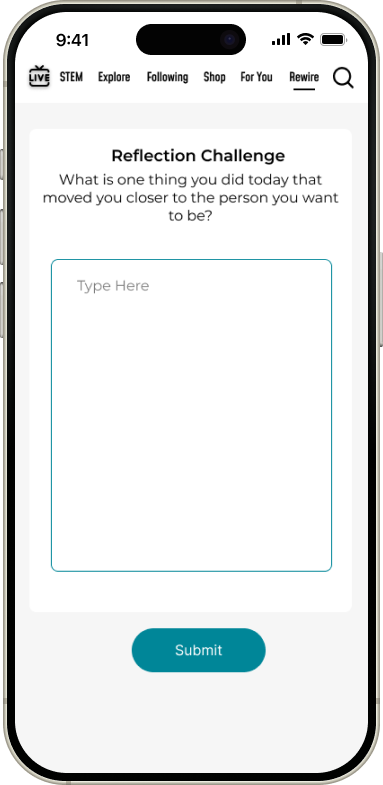
Three types mapped to CoI: Learn (trivia), Connect (message a real person), Reflect (journaling). Short, low-friction, and genuinely meaningful.
Placeholder for Rewire Mode feature image
Feature 04
Rewire Mode
An alternative TikTok feed showing only high-quality, meaningful, socially valuable content. Opt-in — an upgrade, not a restriction.
Four Avatars · Four Drive Theory
Owl
Drive to Learn
Knowledge-seeking users who grow through content
Elephant
Drive to Bond
Community-oriented, motivated by connection
Lion
Drive to Acquire
Goal-driven, motivated by achievement
Beaver
Drive to Defend
Values-driven, habits reflect identity
Ethical design stance
Non-coercive. Transparent. User-controlled.
Nothing is blocked. Every prompt is dismissable. Users set their own limits. Project Rewire is a non-coercive behavioural system — not a parental control.
04 - Design Iterations

What changed. And why.

Every iteration was driven by a specific failure observed in testing, not aesthetic preference. Three areas went through the most significant rounds of change: the microcopy, the challenge system, and the avatar onboarding flow.

01
Microcopy

From excessive to just enough

Before
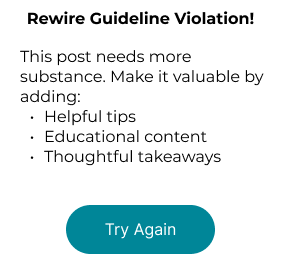
Iteration 1 before prompt screen placeholder
Problem identified in testing

Majority of participants indicated they did want more information about Rewire is about, but the level of detail we included was too much reading.

After
Iteration 1 after prompt screen placeholder
Design decision

Microcopy and other informational points (i.e. challenge scoring) was written to be easily scannable and fast to digest.

Result
In follow-up think-aloud sessions, reported a better understanding of Rewire and ease of informational text.
02
Challenge System

From just gamification to genuine engagement

Before
Iteration 2 before challenge list placeholder
Problem identified in testing

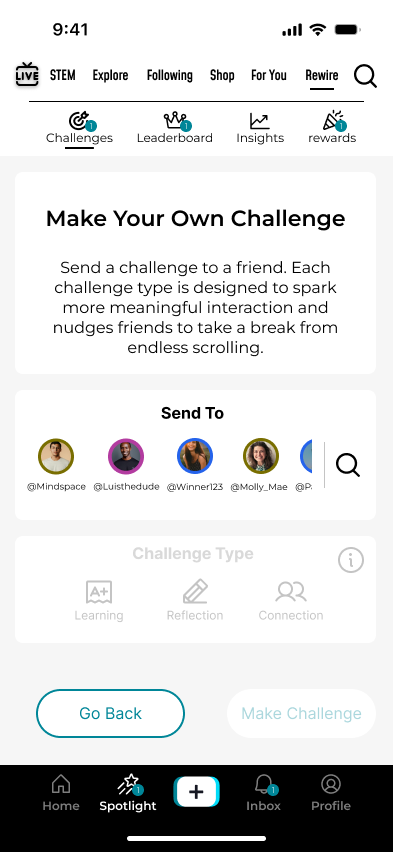
Users only had the option to complete challenges, not send them. We were unintentionally preventing enagement opportunities that users wanted.

After
Iteration 2 after challenge selection placeholder
Design decision

We had actually not made a Make A Challenge ability originally, relying in AI to determine users' level and needs. But users' wanted more control and engagement. Additionally, tap over text is important. Easy choices engagement opportunities created an easier, more seamless experience.

Result
Participants' post-session qualitative feedback shifted from describing challenges as "tasks" to "things I actually wanted to do," a direct signal that the intrinsic motivation framing was working.
03
Avatar Onboarding

From personality test to personal commitment

Before
Iteration 3 before quiz flow placeholder
Problem identified in testing

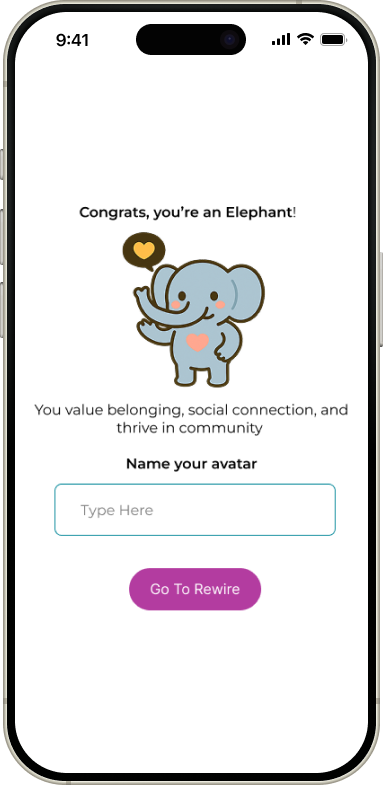
Participants were skipping their avatars by just clicking next or not identifying with it.

After
Iteration 3 after revised quiz placeholder
Design decision

We added the ability to name the avatar as soon as it was assignmented, giving users a chance to personalize it and prevent them simply clicking next and skipping it.

Result
Avatar alignment scores improved with marginal statistical significance in follow-up testing. More importantly, users reported their avatars "matched" their own personalities more.
What iteration taught us
Reactance
Any design that feels controlling, even subtly, triggers resistance before the user processes the message. Autonomy signals must be visible immediately.
Cognitive load
More options reads as more effort. In a moment of attempted behavior change, friction is the enemy. Three choices beat ten every time.
Identity language
The difference between "your personality type" and "your guide" is the difference between a label and a relationship. Copy is UX design.
Evaluation

Testing the system.

Current Testing
  • Avatar alignment — does the matched avatar reflect self-perception?
  • SUS (System Usability Scale) — baseline usability score
  • Think-aloud protocol — real-time reasoning during prototype interaction
Future Validation Plan
  • Stroop test — attention and cognitive control pre/post
  • Memory recall — effect on working memory
  • Critical thinking assessments — depth of reasoning over time
  • Screen time reduction — actual TikTok usage change
  • Mood tracking — longitudinal self-reported affect
Usability Results

Overall results of usability.

Across two rounds, three comparative questions tracked whether the avatar system felt personal, engaging, and psychologically aligned. The layout below preserves space for your final boxplots while matching the rest of the case-study structure.

Comparative Analysis · Rounds 1 & 2

Overall Results of Usability

Q1

Did customizing the avatar make the experience feel more personal or meaningful to you?

Boxplot for avatar personalization question
Iteration 1
Iteration 2
Q2

In your opinion, would the experience feel less engaging if the avatar were removed?

Boxplot for avatar removal engagement question
Iteration 1
Iteration 2
Q3

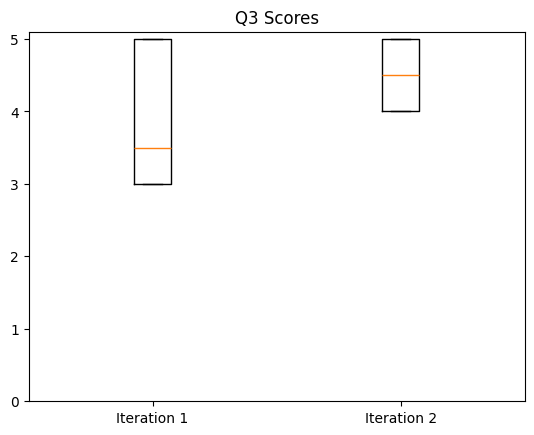
How much do you feel that the avatar you received matches your own personality?

Boxplot for avatar personality match question
Iteration 1
Iteration 2

Boxplot scores on a 1-5 Likert scale comparing Iteration 1 (N=8, ages 25-34) and Iteration 2 (N=8, ages 23-28).

Testing Metrics

SUS and VADER results.

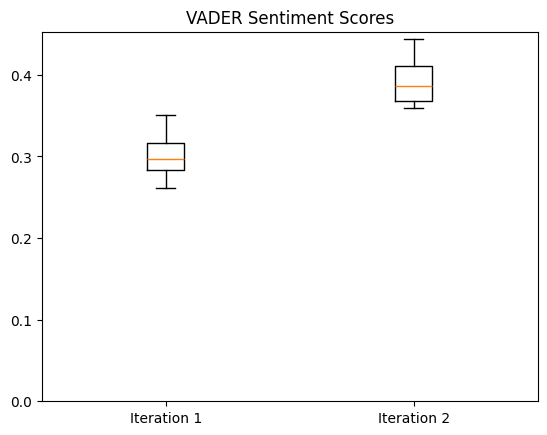
These two comparison views isolate the broader usability signal from the emotional one: the System Usability Scale captures perceived ease of use, while VADER highlights whether the second iteration produced more positive sentiment overall.

Comparative Analysis · Rounds 1 & 2

Results of Usability Testing

SUS Score

Boxplot for SUS score comparison
Iteration 1
Iteration 2

VADER

Boxplot for VADER score comparison
Iteration 1
Iteration 2

Comparing Iteration 1 (N=8, ages 25-34) and Iteration 2 (N=8, ages 23-28). ✕ no statistically significant change ✓ improved

Qualitative Findings

Think-aloud findings across two rounds.

These interview cards translate the two qualitative sandbox files into the case-study’s existing structure: round-level takeaways, quoted wins, and observed points of friction, all within the same content width as the rest of the page.

Qualitative Findings

Results of Usability Testing — Round 1

Qualitative
Method
Think Aloud
Wins

Okay, I'm loving these stats [insights] and that you can view them really easily.

— Participant #1

Oh I'm an Owl! How cute! I love it!

— Participant #3

I like the app, though. You know, like I can see why somebody will probably want to use this.

— Participant #9

Challenges

I'm confused what to do here. What is XP?

— Participant #4

what am I doing? I think it's cool. But is it like, is it [Project Rewire]?

— Participant #1

I like the badges but I'm not going to sit here and read each one.

— Participant #9

Quotes captured verbatim during think-aloud sessions · Round 1 · N = 8 · Ages 25–34

Qualitative Findings

Results of Usability Testing — Round 2

Qualitative
Method
Think Aloud
Wins

The everything…the whole challenge flow was very easy.

— Participant #18

It [the avatar assignment] is very true about myself.

— Participant #12

Look, this is fun. I've literally been wanting something like this”

— Participant #17

Challenges

I feel like this is intrusive and I don't want to read this much

— Participant #11

Mm-hmm. Like just being like. I'm your owl, I'm THE owl. I'm something like, hello, my name is blah blah blah. [Give me more personalized, more in-depth or more personal to ME individually]

— Participant #17

Quotes captured verbatim during think-aloud sessions · Round 2 · N = 8 · Ages 25–34

Results Summary

What changed across rounds.

This synthesis compresses the full evaluation set into one view: three avatar-related questions, SUS, and VADER. The clearest movement came from sentiment, where VADER was the only statistically significant measure and showed the strongest overall effect.

MindOS · HCDE 591 · Project Rewire

Summary of results

Q #1 not sig.
no mean change
var. -0.15
effect size
none
Q #2 not sig.
+0.75
mean change
var. -0.44
effect size
medium-large
Q #3 nearly sig.
+0.63
mean change
var. -0.43
effect size
large
SUS not sig.
+7.19
mean change
var. -7.24
effect size
medium
VADER sig. ✓
+0.092
mean change
var. -0.031
effect size
extremely large
statistically significant
approaching significance
not significant
bars show normalized mean change relative to each measure's scale range
Expert Review

Two experts. One clear direction.

Behavioral psychology feedback helped validate the concept while sharpening where Project Rewire needs the most care: execution, ethical clarity, and long-term behavior change support.

Dr. Siefert — Clinical Psychology & Behavioral Science
Dr. End — Research / Behavioral Psychology
Both experts validated the overall direction of Project Rewire. While they raised important cautions around execution, moderation, and behavior change limits, the broader takeaway was encouraging: the concept is psychologically grounded, strategically promising, and worth developing further through careful iteration.

Both experts agreed

The problem is real and worth solving

Both experts treated the core issue as legitimate rather than manufactured. The concept responds to an actual behavioral and cognitive challenge users already experience.

Friction matters more than persuasion

Prompts work best when they interrupt automatic behavior. The value is not in lecturing the user, but in breaking the loop long enough for reflection to happen.

The avatar system has strong potential

Emotional investment in the avatar was seen as one of the most promising parts of the concept. It adds care and identity in a way other features do not.

Execution and testing will determine success

Both experts framed validation as a starting point, not a finish line. Real user behavior and iteration will matter more than theoretical promise alone.

Key cautions raised

Behavior change will not be universal

The strongest impact is likely to come from users who already recognize the problem and want help changing it. This is not a universal cure-all.

Direct messaging needs safeguards

Direct messages can create the richest form of authentic connection, but also carry the most interpersonal risk. Moderation and structure are important.

Rewards should scaffold, not dominate

Extrinsic rewards are useful here, but they should support the deeper intrinsic motivation and goal of reflection, habit interruption, and self-awareness rather than becoming the whole experience.

The framing should stay ethically transparent

The concept was not seen as manipulative, but users should understand what prompts do, why they appear, and how much control they have over them.

Final Verdict

Project Rewire is a credible, psychologically grounded intervention. The strongest path forward is to position it as a personalized, friction-based support tool for users who already want to change their relationship with doomscrolling, then validate the details through iterative testing.

View each question and the experts' answers
Question 1 of 14

Question #1: Do any of these features create authenic interaction? If so, which one(s)?

Dr. Siefert

Authenticity varies by depth: avatars create broad, low-effort engagement, while direct messaging can enable deeper reflection for fewer users.

Dr. End

Direct messaging has the strongest potential for authentic interaction, but also the highest risk, while other features depend heavily on execution and user comfort.

Conclusion

Authentic interaction is not guaranteed by social features alone; it emerges when design supports either low-friction identity (avatars) or deeper, psychologically safe reflection (DMs), with depth varying by user readiness.

Final Design

The screens.

Add your final high-fidelity screens below. Each card links to a key flow in the product.

Reflection

What this project taught me.

Key Contributions
  • Led research synthesis — interviews, focus groups, affinity mapping
  • Connected Four Drive Theory to concrete design decisions in avatar personalization and CoI to challenges design decisions.
  • Drove the non-coercive ethics framework as a core principle
  • Wrote UX microcopy for avatar prompts, challenges, and onboarding
  • Created "Friend Authored Challenges": using prosocial peer pressure to encourage engagement and connection
Ongoing Challenges
The hardest tension was building something that changes behaviour without being controlling or policing. Every friction addition risked making users feel controlled; every reduction risked having no impact.

The solution: make user autonomy the non-negotiable core, and let everything else a trade-off. Next step is proving that meaningful engagement actually improves cognitive outcomes, not just satisfaction scores.
This project reinforced my belief that the most important UX work happens at the intersection of research, behavioural science, and ethics. Designing for attention isn't a usability problem. It's a question of what kind of relationship a product should have with its users.
Next case study
MealMap